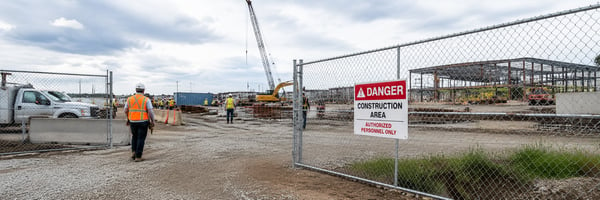
Quick answer: Aluminum Composite Material (ACM) is a three-layer panel made of two thin aluminum skins bonded to a polyethylene core. It looks identical to solid aluminum signage, performs comparably in most outdoor and indoor applications, and costs roughly 25–27% less, a meaningful gap now that Section 232 tariffs on aluminum have hit 50% and the all-in delivered cost of U.S. aluminum has more than doubled since 2018.
For most safety, parking, wayfinding, property, and facility signs, ACM is the smarter buy. Solid aluminum remains the right choice for MUTCD-regulated traffic signs, weldable structures, and high-impact zones.
Key Takeaways
- ACM is approximately 25–27% cheaper than solid aluminum for comparable signage at SafetySign.com.
- It weighs about half as much, lowering shipping, hardware, and installation costs.
- It meets OSHA 29 CFR 1910.145 and ANSI Z535 standards for safety signage.
- Select grades carry UL 94V-0 and ASTM E-84 Class A fire ratings.
- Lifespan is 10+ years outdoors with multi-year manufacturer warranties.
- Not recommended for: MUTCD traffic signs, welded structures, high-impact vehicle zones, or applications requiring powder coating.
- OSHA/ANSI safety signs — Danger, Warning, Caution, Notice, PPE, chemical hazard
- Property and security signs — No Trespassing, Private Property, video surveillance
- Wayfinding and facility signs — directories, room IDs, directional signage
- Parking signs — reserved, ADA, fire lane, visitor, regulation
- Fire, exit, and emergency signs — extinguisher locations, evacuation routes, assembly points
- Custom signs — logos, bilingual content, branded messaging
- Lower shipping costs — half the weight means lower freight charges
- Faster installation — lighter signs mount more quickly with less labor
- Lighter mounting hardware — reduced load may eliminate heavy-duty brackets
Why Are Aluminum Signs So Expensive Right Now?
Three forces have pushed aluminum signage to historic price levels:
1. Commodity prices are up. The London Metal Exchange benchmark for primary aluminum sits at roughly $3,100–$3,200 per metric ton in early 2026: about $1.45 per pound, more than 18% higher than a year prior.
2. The Midwest Premium has exploded. This U.S.-specific surcharge passed $2,100 per metric ton in February 2026, the first time it has ever crossed the $1-per-pound mark. The all-in delivered cost of aluminum to U.S. buyers now exceeds $5,300 per metric ton, more than double pre-tariff levels.
3. Section 232 tariffs are at 50%. Here is the timeline:
|
Date |
Tariff Action |
|
2018 |
Initial 10% Section 232 tariffs imposed on aluminum imports |
|
Feb 2025 |
All country exemptions and exclusions eliminated |
|
Jun 2025 |
Tariff rate raised from 25% to 50% — the highest Section 232 rate ever |
|
Aug 2025 |
400+ additional product categories added to coverage |
The practical result: a facility ordering 50, 100, or several hundred signs is paying materially more than it did two years ago. That is the gap ACM closes.
What Is Aluminum Composite Material (ACM)?
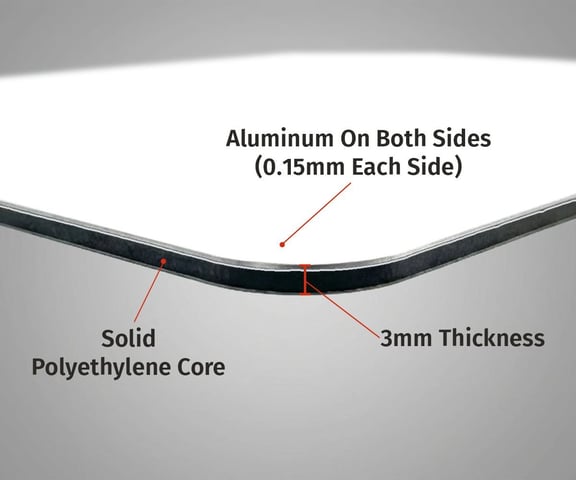
Aluminum Composite Material (ACM), sometimes called Aluminum Composite Panel (ACP), is an engineered three-layer panel:
- Front aluminum skin — a pre-finished aluminum sheet, typically 0.012" (0.3mm) thick
- Polyethylene (PE) core — a solid thermoplastic center providing rigidity and impact resistance
- Back aluminum skin — a matching aluminum sheet completing the sandwich
ACM panels for signage are typically 3mm thick — the same nominal thickness as common solid aluminum sign blanks — and achieve comparable or superior flatness through their composite construction.
The aluminum skins deliver the metallic appearance, weather resistance, and printability buyers expect. The polyethylene core delivers structural rigidity at a fraction of the weight and cost of solid aluminum sheet.
How ACM Is Manufactured
ACM is produced through continuous lamination — aluminum coil stock is bonded to the polyethylene core under heat and pressure. The aluminum skins are pre-painted before bonding, so finished panels arrive ready for printing, cutting, or fabrication with no additional finishing required. They cut cleanly with standard sign-shop equipment, route well on CNC machines, and don’t require deburring.
ACM vs. Solid Aluminum: Side-by-Side Comparison
|
Property |
3mm ACM Panel |
.063" Solid Aluminum |
.080" Solid Aluminum |
|
Weight |
~50% of solid aluminum |
Baseline |
Heavier |
|
Cost vs. solid aluminum |
~25% less |
Baseline |
Higher |
|
Flatness |
Excellent — resists oil-canning |
Good |
Good |
|
Rigidity |
High (sandwich structure) |
Moderate |
High |
|
Weather resistance |
Excellent |
Excellent |
Excellent |
|
UV resistance |
Excellent (coated skins) |
Excellent |
Excellent |
|
Printability |
Excellent — UV, latex, screen, vinyl |
Excellent |
Excellent |
|
Fire rating |
UL 94V-0; ASTM E-84 Class A (select grades) |
Non-combustible |
Non-combustible |
|
Welding |
Not possible |
Yes |
Yes |
|
Powder coating |
Not possible |
Yes |
Yes |
When Should You Choose ACM?
ACM is the right choice for the vast majority of facility and safety signage applications, including:
- OSHA/ANSI safety signs — Danger, Warning, Caution, Notice, PPE, chemical hazard
- Property and security signs — No Trespassing, Private Property, video surveillance
- Wayfinding and facility signs — directories, room IDs, directional signage
- Parking signs — reserved, ADA, fire lane, visitor, regulation
- Fire, exit, and emergency signs — extinguisher locations, evacuation routes, assembly points
- Custom signs — logos, bilingual content, branded messaging
Anywhere you previously specified solid aluminum for an indoor or outdoor sign that won’t be regularly struck, welded, or powder-coated, ACM is almost certainly the better economic choice.
When Should You Stick with Solid Aluminum?
Solid aluminum still wins in five specific scenarios:
- MUTCD traffic and roadway signs. Federal and state DOT specifications require specific aluminum gauges
- Welded sign structures: ACM cannot be welded (the polyethylene core)
- High-impact zones: areas with regular forklift, vehicle, or equipment strikes
- Powder-coated finishes — the oven-baking process damages the PE core
- Large unsupported spans with structural loads — through-thickness strength matters
Being honest about this distinction is part of choosing the right material — not just the cheaper one.
How Much Money Does ACM Actually Save?
ACM signage runs approximately 25–27% below comparable solid aluminum at SafetySign.com.
Real-world example: A mid-size distribution center needs 75 new safety, wayfinding, and parking signs.
|
Material |
Avg. Cost per Sign |
Total Order |
|
Solid aluminum |
$40 |
$3,000 |
|
ACM |
~$29 |
~$2,190 |
|
Savings |
|
~$810 |
That’s the direct material savings. The indirect savings stack on top:
- Lower shipping costs — half the weight means lower freight charges
- Faster installation — lighter signs mount more quickly with less labor
- Lighter mounting hardware — reduced load may eliminate heavy-duty brackets
There’s a fourth, less obvious benefit: budget predictability. Because ACM uses significantly less aluminum per panel, its price is less sensitive to commodity market swings — useful in a tariff environment that keeps shifting.
Does ACM Meet Safety and Compliance Standards?
For most applications: yes.
The two main regulatory frameworks for facility safety signage: OSHA 29 CFR 1910.145 and the ANSI Z535 series — specify requirements for sign design, color, signal words, and placement. Neither prescribes a specific substrate material. What they require is that the sign be durable enough for its environment and clearly communicate the hazard.
ACM meets both. Its smooth, pre-finished surface produces vibrant, high-contrast graphics that meet ANSI Z535 color standards, and its weather and UV resistance keeps signs legible for years.
Fire and electrical compliance: Select ACM grades meet UL 94V-0 flammability standards and qualify as ASTM E-84 Class 1 / Class A materials, making them recognized components for electrical signage under UL 879.
The exception: MUTCD-regulated traffic and highway signs typically require solid aluminum at specified gauges. ACM is not a substitute here.
How Long Does ACM Signage Last?
With normal installation and reasonable environmental conditions, ACM signage performs well outdoors for 10+ years. Leading manufacturers back panels with warranties of up to 10 years on bond integrity and 5 years on outdoor finish performance.
For most signage, which is often updated within that window for rebranding, regulatory changes, or facility modifications, ACM’s lifespan is more than sufficient.
Maintenance is minimal: occasional cleaning with mild soap and water. The pre-finished aluminum skins resist dirt accumulation, graffiti, and routine chemical exposure.
Frequently Asked Questions
What does ACM stand for in signage?
ACM stands for Aluminum Composite Material. It’s also called ACP (Aluminum Composite Panel). Both terms refer to the same three-layer panel: two aluminum skins bonded to a polyethylene core.
Is ACM the same as Dibond, Alupanel, or Maxmetal?
Yes. Dibond, Alupanel, Maxmetal, and similar names are brand-name versions of ACM. The construction (aluminum/PE/aluminum) is the same across brands, though grades and warranties vary.
Can ACM signs be used outdoors?
Yes. ACM panels are engineered for outdoor use and resist rain, snow, humidity, UV exposure, and temperature swings without warping, fading, or delaminating.
How thick is ACM signage?
Most ACM signage panels are 3mm thick, matching the nominal thickness of common solid aluminum sign blanks.
Can ACM be printed on?
Yes. ACM accepts UV-curable ink, latex ink, screen printing, and pressure-sensitive vinyl. Many sign professionals report that ACM’s surface consistency produces sharper graphics than solid aluminum.
Is ACM OSHA-compliant?
Yes. For safety signage. OSHA 29 CFR 1910.145 specifies design and color requirements but does not mandate a specific substrate material. ACM signs meeting OSHA design standards are compliant.
Can ACM signs be used as traffic signs?
No. MUTCD-regulated traffic signs and highway signs require solid aluminum substrates of specific gauges. ACM is not a substitute for these applications.
Why is ACM cheaper than solid aluminum?
ACM uses significantly less aluminum per panel — two thin skins instead of a solid sheet. Less aluminum content combined with efficient lamination manufacturing produces lower material and shipping costs, especially under current 50% Section 232 tariffs.
Can you weld or powder-coat ACM?
No to both. The polyethylene core cannot withstand welding heat or the oven-baking temperatures used in powder coating. For these processes, solid aluminum is required.
How do you cut and fabricate ACM?
ACM cuts cleanly with standard sign-shop equipment, routes well on CNC machines, and doesn’t require deburring. Most fabricators find it faster to work with than solid aluminum.
The Bottom Line
The aluminum market in 2026 has changed the math for sign buyers. Tariffs at 50%, record Midwest Premiums, and tightened domestic supply mean every dollar spent on signage has to work harder.
ACM lets you keep about 27% of your material budget for other priorities — without sacrificing the professional appearance, durability, or compliance that safety and facility signage demand. It isn’t a replacement for solid aluminum in every situation, but for the thousands of safety, parking, property, fire, emergency, and custom sign applications that make up most facility orders, it’s the smarter call.
Ready to price out ACM for your next sign order? Visit SafetySign.com or contact our team to talk through your specific application.
Sources
- Trading Economics. “Aluminum Price — Commodity.” February 2026.
- Financial Content / MarketMinute. “Aluminum Midwest Premium Hits Record $2,182.” February 25, 2026.
- Congressional Research Service. “Expanded Section 232 Tariffs on Steel and Aluminum.” IN12519. September 2025.
- White & Case LLP. “Trump Administration Increases Steel and Aluminum Section 232 Tariffs to 50%.” June 2025.
- U.S. Department of Commerce, BIS. “Department of Commerce Adds 407 Product Categories to Steel and Aluminum Tariffs.” August 2025.
- Curbell Plastics. “Aluminum Composite Material — Properties and Applications.”
- Polymershapes. “Aluminum Composite Material (ACM) Sheets.”
- Laird Plastics. “Aluminum Composite Panels (ACM) | ACM Sheet.”
- Grimco / Maxmetal. “Not All ACM Is the Same.” February 2025.
- Cherwell Signs. “Aluminium vs Aluminium Composite: Which Is Best for Signage?” June 2025.
- OSHA. 29 CFR 1910.145 — Specifications for Accident Prevention Signs and Tags.
- Brady Corporation. “ANSI Z535 — 6 Part Standard for Safety Signs.”