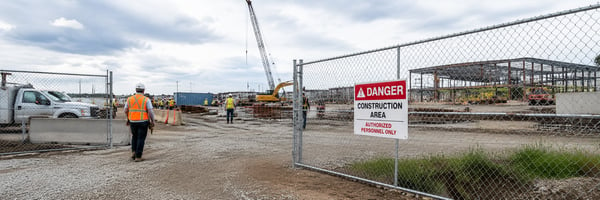
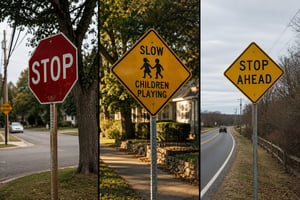
What are construction safety signs?
Construction safety signs are signs posted on job sites to warn workers and visitors of hazards, communicate requirements, and ensure the site remains compliant with OSHA regulations. They cover hazards such as falls, hard-hat and PPE requirements, restricted access, excavation and open trenches, electrical hazards, and heavy equipment areas. Their purpose is to prevent accidents by making hazards and rules visible before someone reaches them.
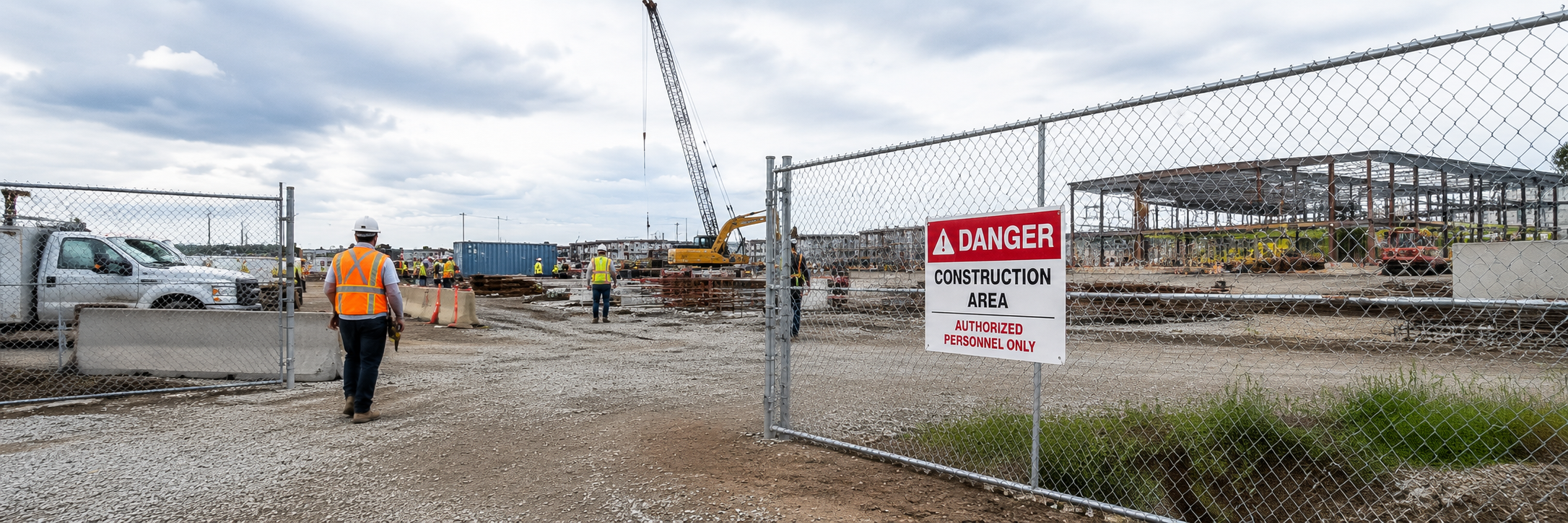
On an active site, signage is one of the simplest and most cost-effective layers of safety. It does not replace training, barriers, or PPE, but it reinforces all three by communicating expectations clearly and consistently.
What OSHA regulations apply to construction safety signs?
OSHA’s construction signage rule, 29 CFR 1926.200, requires construction sites to post accident prevention signs and tags. Signs are expected to follow ANSI Z535.2 conventions for color coding, signal words, and placement, so that workers, inspectors, and emergency responders interpret them the same way.
The practical takeaway is that a compliant construction sign is not just any sign with a warning on it. It uses the correct signal word for the level of hazard, the standardized colors and formatting, and is placed where it will be seen before the hazard is encountered.
Danger vs. Warning vs. Caution: what is the difference?
These three signal words are not interchangeable. They communicate different levels of risk under the ANSI Z535 system, and using the right one matters for both safety and compliance.
|
Signal word |
Hazard level |
Meaning |
|
Danger |
Highest |
An immediately hazardous situation that will result in death or serious injury if not avoided |
|
Warning |
Middle |
A potentially hazardous situation that could result in death or serious injury |
|
Caution |
Lowest |
A potentially hazardous situation that may result in minor or moderate injury |
Choosing the signal word follows the severity of the consequence, not just the presence of a hazard. Reserve Danger for the most serious, immediate threats so that it retains its weight on the site.
Types of construction safety signs
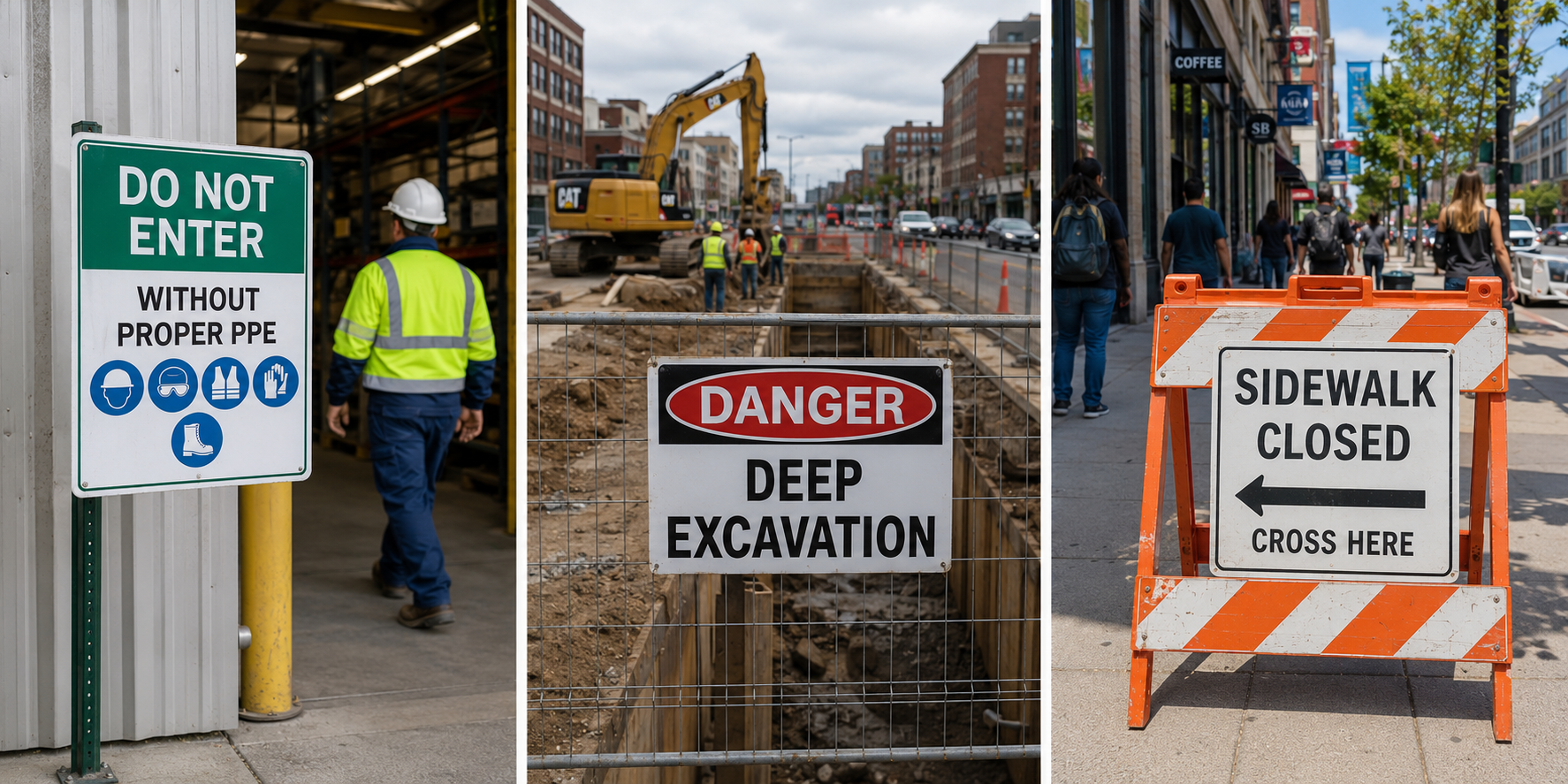
Construction sites need a range of signs because they contain many different hazards and access rules. The categories below are the most common, and you can browse the full selection on the construction safety signs collection.
Site access and security
These control who enters and remind visitors of the rules. Examples include the Construction Area Authorized Only Sign, Construction Area Keep Out Sign, and Construction Site No Trespassing Sign. See more under construction no trespassing signs and construction entrance signs.
PPE and dress code
These communicate the protective equipment required on-site, which is especially important when requirements vary by zone. Examples include the Required PPE Must Be Worn Sign, Hard Hats Required on Job Site Sign, and Site Safety Mandatory PPE Sign. Browse construction PPE signs and jobsite dress code signs.
Specific hazard warnings
These mark particular dangers present on the site. Relevant collections include excavation warning signs, open trench safety signs, scaffold and ladder safety signs, crane safety signs, and men working above signs.
Site information and rules
These set expectations at entry points. Examples include the Construction Area Rules Sign, Site Safety Rules and PPE Required Sign, and the Construction Site Entrance Sign. See also site safety signs and construction site safety banners.
Pedestrian and public protection
Sites near sidewalks and roads need to protect the public, too. See sidewalk closed signs and road work signs.
What sign material is best for a construction site?
Material choice comes down to how long the sign needs to last and the conditions it faces.
|
Material |
Best for |
Notes |
|
.040 aluminum |
Permanent and long-term outdoor postings |
Weatherproof, rust-resistant, designed to last years outdoors |
|
Aluminum composite (ACM) |
Larger format and long-term signage on a budget |
Lightweight and durable, a cost-effective alternative to solid aluminum |
|
Rigid plastic |
Temporary postings |
Durable for shorter-term needs, lighter weight |
|
Corrugated plastic |
Short-term job site use |
Cost-effective for sites that change frequently |
For most outdoor construction signage that stays up through a project, aluminum is the durable default. Corrugated plastic makes sense when a sign only needs to last for a phase of work.
Consider aluminum composite (ACM) for larger or budget-conscious signage
Aluminum Composite Material (ACM) is a three-layer panel made of two thin aluminum skins bonded to a solid polyethylene core. It is a strong, flat, and durable option that sits between solid aluminum and plastic, and it is a good fit for larger construction and site signage where solid aluminum would be heavy or costly.
The main advantages for job sites are weight and cost. ACM is approximately 50% lighter than solid aluminum, making large signs easier to handle, install, and ship between sites, and it typically costs about 20% less. It is built for outdoor use, resisting UV, rain, snow, and temperature extremes. Because OSHA and ANSI Z535 govern sign design rather than the substrate, safety signs printed on ACM still meet those requirements.
Solid aluminum is still the better choice for highway or DOT traffic signs, extreme wind environments, and locations with repeated heavy impacts such as forklift strike zones. For most other construction and facility signage, ACM is a practical, cost-effective panel. Learn more on the aluminum composite sign material page.
Bilingual signs and diverse crews
Many construction crews include workers whose first language is not English, and a sign only works if it is understood. Bilingual English and Spanish signs, such as the Bilingual Danger Construction Area Authorized Only Sign, help communicate hazards and rules across a diverse workforce. Most popular construction designs are available in bilingual versions.
Customizing construction signs
Standard signs cover common hazards, but sites often need to add a contractor name, a job site address, a specific hazard, or a company logo. Custom options let you do this while keeping the required safety elements intact. See custom safety signs and job-site-specific options like the custom jobsite sign and banner, or build a header from a custom OSHA sign or custom ANSI sign template.
Frequently asked questions
What OSHA regulation requires construction safety signs?
OSHA 29 CFR 1926.200 requires construction sites to post accident prevention signs and tags, and signs are expected to follow ANSI Z535.2 for color coding, signal words, and placement.
What is the difference between Danger, Warning, and Caution signs?
Danger indicates an immediately hazardous situation that will result in death or serious injury. Warning indicates a potentially hazardous situation that could result in death or serious injury. Caution indicates a potentially hazardous situation that may result in minor or moderate injury.
What material is best for outdoor construction signs?
.040 aluminum is the standard for outdoor construction signs because it is weatherproof, rust-resistant, and built to last for years. Corrugated plastic is a cost-effective option for short-term or temporary job sites.
Can I get construction signs with custom text?
Yes. Custom sign tools let you add contractor names, job site addresses, specific hazard warnings, and company logos to standard construction sign designs.
Are bilingual construction safety signs available?
Yes. English and Spanish bilingual versions of popular construction safety signs are available, which help communicate hazards across diverse crews.
Outfit your job site
A compliant site uses the right signal word for each hazard, durable materials suited to the conditions, and signs placed where they will be seen. Start with the construction safety signs collection, add the PPE and hazard-specific signs your site needs, and customize where a standard design does not fit.
Setting up a new site or managing several? Call the SafetySign.com team at 800-274-5271.