
What are construction safety signs? Construction safety signs are signs posted on job sites to warn...
What are chemical hazard signs?
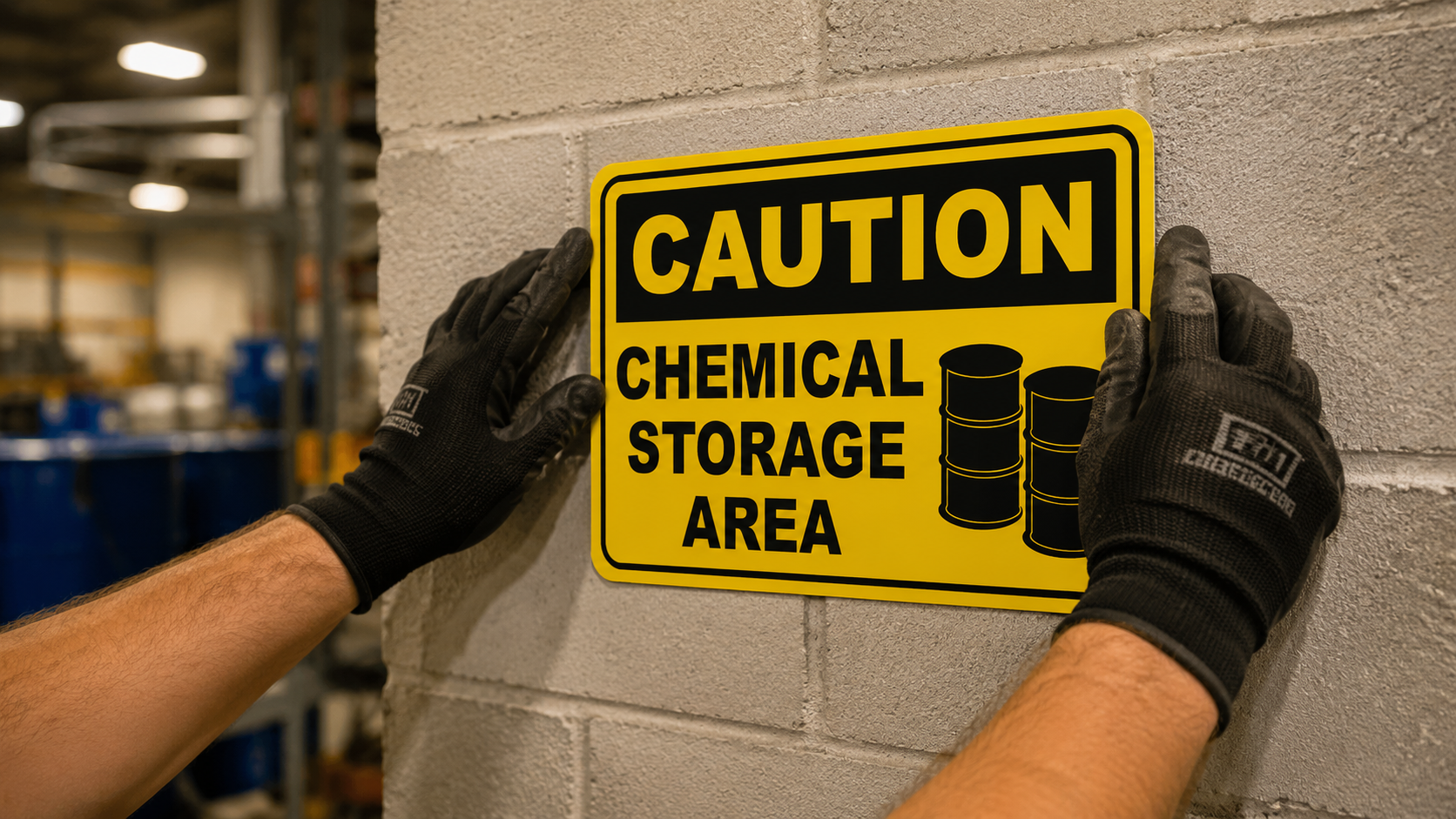
Chemical hazard signs are signs and labels that communicate the dangers of chemicals in a workplace, including how to store, handle, and respond to them. They identify hazards such as flammability, corrosivity, and toxicity using standardized words, colors, and symbols so that employees, inspectors, and emergency responders all interpret them consistently. Their job is to warn people of a chemical hazard before contact happens.
Chemical hazards exist in far more workplaces than just chemical plants. Construction crews may encounter paints, asphalt fumes, or crystalline silica, and many facilities store cleaning agents, fuels, or compressed gases. Anywhere hazardous chemicals are present, clear signage is part of communicating the risk.
What does OSHA require for chemical hazard communication?
OSHA requires employers with hazardous chemicals in the workplace to communicate those hazards to employees through labeling, safety data sheets (SDS), and training. This framework is OSHA’s Hazard Communication Standard, codified at 29 CFR 1910.1200, often abbreviated as HazCom.
Under OSHA’s definition, a hazardous chemical is any chemical or substance that can pose health hazards or physical hazards. Health hazards include effects such as acute toxicity, skin corrosion or irritation, serious eye damage, respiratory or skin sensitization, carcinogenicity, and reproductive toxicity. Physical hazards include properties such as being flammable, being an oxidizer, being corrosive to metal, or being a gas under pressure. The full criteria are detailed in the appendices to 29 CFR 1910.1200.
The main chemical hazard labeling systems
Several standardized systems are used on chemical signs and labels, and a facility often uses more than one depending on the chemical and the setting.
|
System |
What it is |
Where it is used |
|
GHS / HazCom |
The Globally Harmonized System used in OSHA’s Hazard Communication Standard, with standardized pictograms and signal words |
Workplace container labels and signage |
|
NFPA 704 |
The fire-safety diamond rating health, flammability, instability, and special hazards |
Buildings, storage areas, and entrances for emergency responders |
|
DOT placards |
Department of Transportation hazard placards for shipping |
Vehicles and containers in transport |
GHS and NFPA serve different audiences. GHS labeling communicates to workers handling the chemical day to day, while the NFPA 704 diamond is designed to give emergency responders a fast read on the hazards inside a space. Both have their place in a fully labeled facility.
Types of chemical hazard signs
Chemical signage spans hazard communication, identification, and storage. You can browse the full range on the chemical signs collection.
Hazard communication and rating
These convey the standardized hazard information. See GHS signs, HazCom signs, NFPA 704 diamonds, and SDS signs that direct workers to safety data sheets.
Chemical identification
These name the specific substances present. See chemical identification signs, with dedicated options for common chemicals such as acid, ammonia, chlorine, carbon monoxide, oxygen, and crystalline silica.
Storage and waste
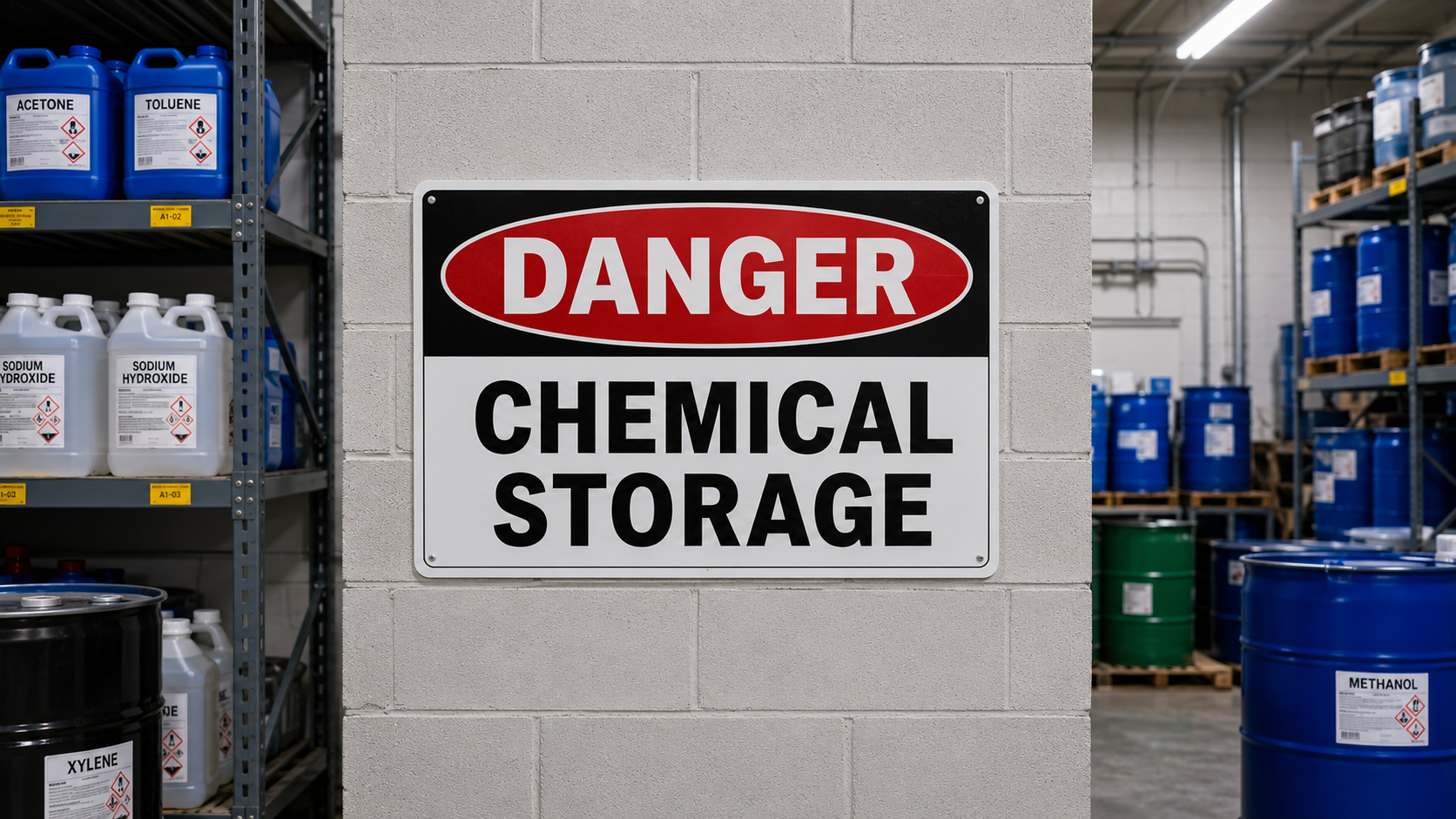
These govern safe storage and disposal. See chemical storage signs, hazardous waste signs, hazardous waste labels, and gas cylinder signs.
Transport and specialty
These cover shipping and specific regulatory needs, including DOT placards, GHS pipe markers, pesticide signs, and Prop 65 signs.
Labels for containers and equipment
For drums, containers, and point-of-use marking, see chemical hazard labels and health hazard labels.
How to choose the right chemical signs
Identify the chemical and its hazards first. The specific substance and whether it poses health hazards, physical hazards, or both determines which signs and symbols you need. Safety data sheets are the source for this information.
Match the system to the audience. Use GHS and HazCom labeling for workers handling chemicals, NFPA 704 diamonds at entrances and storage areas for emergency responders, and DOT placards for anything in transport.
Choose materials for the environment. Vinyl labels suit drums and containers, while rigid aluminum holds up on walls and in outdoor storage areas where durability and visibility matter most.
Place signs before the point of contact. Position signage near storage cabinets, on chemical drums, at lab and storage room doors, and at building entry points where hazardous substances are inside, so the warning comes before exposure.
A note on accuracy
Chemical hazard signage depends entirely on your specific chemicals, facility, and applicable regulations. The right signs for one facility may not suit another, and it is the employer’s responsibility to determine which signs are valid for a given use and to comply with the applicable laws and standards. Consult your safety data sheets and a qualified safety professional and treat this guide as an overview rather than a substitute for expert analysis. For OSHA’s own resources, see OSHA’s chemical hazards information at osha.gov.
Frequently asked questions
What OSHA standard covers chemical hazard signs?
OSHA’s Hazard Communication Standard, 29 CFR 1910.1200, requires employers to communicate chemical hazards through labeling, safety data sheets, and training. Signage supports this by making workplace hazards visible.
What is the difference between GHS and NFPA labeling?
GHS labeling, used in OSHA’s HazCom standard, communicates hazards to workers handling chemicals through standardized pictograms and signal words. The NFPA 704 diamond is designed to give emergency responders a quick read of the health, flammability, and instability hazards inside a space.
What is an NFPA 704 diamond?
It is the color-coded, four-section diamond that rates a material’s health, flammability, and instability hazards, as well as special hazards, so responders can assess danger at a glance.
Which material works best for chemical signs?
It depends on the location. Vinyl labels work well on drums and containers, while rigid aluminum is better for walls and outdoor storage areas where durability and visibility are critical.
Where should chemical signs be placed?
Wherever someone might encounter the hazard, including near storage cabinets, on chemical drums, at lab and storage doors, and at building entry points when hazardous substances are inside. The goal is to warn before contact.
Label your facility for compliance
Effective chemical hazard communication combines the right systems, the right materials, and correct placement. Start with the chemical signs collection, add GHS and NFPA signage for your hazards, and use chemical hazard labels for containers and points of use.
Need help identifying the right signs for your chemicals? Call the SafetySign.com team at 800-274-5271 and always confirm requirements against your safety data sheets and applicable regulations.