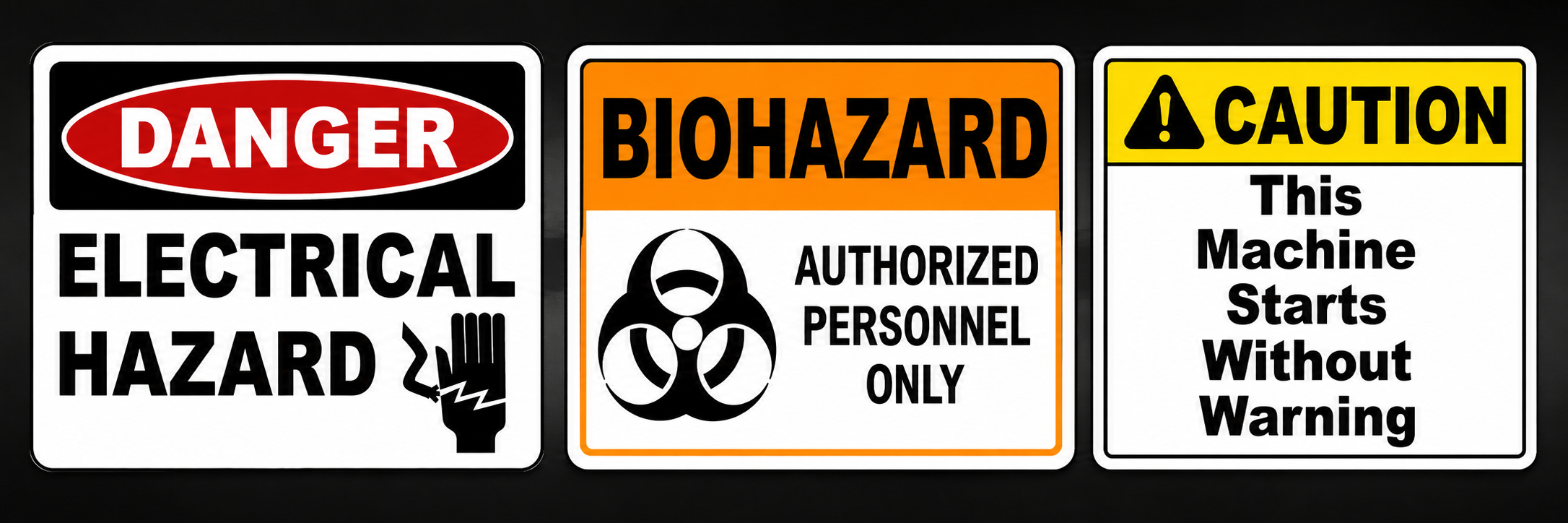
Hazard identification and warning signs are standardized visual alerts, built around the ANSI Z535 signal word system (Danger, Warning, Caution, Notice), that tell workers and visitors the type and severity of a hazard before they encounter it. In the United States, their design is shaped by two overlapping frameworks: ANSI Z535 (the voluntary consensus standard that defines colors, symbols, and wording) and OSHA 29 CFR 1910.145 (the federal rule that makes basic sign specifications enforceable in general industry). Getting the hierarchy and the sourcing right matters for both worker safety and liability exposure.
 What Counts as a Hazard Identification or Warning Sign?
A hazard identification sign communicates a specific risk (electrical shock, moving machinery, a fall hazard, a biological agent, restricted access) using a standardized signal word, color, and, often, a pictogram. They differ from purely informational or directional signage in one key way: they exist to change behavior before an incident occurs, not just to label a location.
Common categories include:
- Electrical hazard signs (high voltage, arc flash, lockout/tagout points)
- Mechanical and machine-guarding signs (pinch points, moving parts, crush hazards)
- Fall and elevation hazard signs (open edges, floor openings, ladder access)
- Confined space signs (permit-required entry warnings)
- Biological hazard signs (BIOHAZARD symbol, infectious material handling)
- Chemical hazard signs (a large enough category that we cover it in depth separately; see our Chemical Hazard Signs and Labeling guide)
- General facility hazard signs (restricted access, PPE-required zones, equipment-specific cautions)
The ANSI Z535 Signal Word Hierarchy
The core of any hazard identification program is choosing the correct signal word. ANSI Z535.2 (environmental and facility signs) and Z535.4 (product safety signs and labels) define four tiers, each with a mandated color and a specific severity meaning:
|
Signal Word |
Header Color |
What It Means |
Typical Use |
|
Red header, white text |
Immediate hazard that will result in death or serious injury if not avoided |
Live electrical panels, unguarded high-speed machinery |
|
|
WARNING |
Orange header, black text |
Hazard that could result in death or serious injury |
Elevated platforms without full guarding, high-pressure lines |
|
CAUTION |
Yellow header, black text |
Hazard that could result in minor or moderate injury |
Wet floors, low overhead clearance, minor pinch points |
|
NOTICE |
Blue header, white text |
Property damage or procedural information, not personal injury |
Equipment care instructions, no-injury procedural rules |
Under OSHA's older 1910.145 sign specification, only "Danger" and "Caution" (with "Warning" as an optional intermediate) carry explicit color rules: red/black/white for Danger, and yellow with a black panel for Caution. Most manufacturers and safety programs, including ours, design to the more detailed and more current ANSI Z535 palette because it's the version referenced in modern OSHA guidance and in most corporate EHS programs.
A practical rule for choosing between them: if you're unsure whether a hazard is "Danger" or "Warning," ask whether death or serious injury is the likely outcome of an incident (Danger) or merely a possible one (Warning). Overusing "Danger" dilutes its effect and can itself become a compliance and training problem. Safety professionals generally advise reserving it for the most severe, immediate hazards only.
OSHA vs. ANSI: Which One Is "The Law"?
This distinction trips up a lot of buyers, so it's worth stating plainly: ANSI Z535 is a voluntary consensus standard; OSHA 29 CFR 1910.145 is a binding federal regulation. However, OSHA has repeatedly cited ANSI Z535 in interpretation letters and general duty clause enforcement as evidence of an accepted industry practice. In practice, that means:
- Following ANSI Z535 is not, by itself, a legal requirement in most general industry settings.
- Ignoring it while also failing OSHA's baseline sign rules is a much weaker legal position if an incident occurs.
- Many industry-specific standards (construction, maritime, certain state OSHA plans) do incorporate ANSI Z535 by reference, which makes it mandatory in those contexts.
State OSHA plans update independently, so which states currently mandate ANSI Z535 by reference for general industry can vary and change over time. Check your specific state plan (if applicable) and the current text of 29 CFR 1910.145 before treating either standard as optional.
Pictograms, GHS, and Where Hazard Signs Overlap With Labels
Hazard identification signs frequently work alongside two other symbol systems:
- GHS pictograms (the black-and-white diamond symbols required under OSHA's Hazard Communication Standard, 29 CFR 1910.1200); these apply to chemical labels and safety data sheets specifically, not general facility signage.
- NFPA 704 diamonds, used for chemical storage and fire response, distinct from ANSI Z535 facility signs.
A hazard identification sign can, and often should, combine an ANSI Z535 signal word panel with a relevant pictogram (electrical bolt, biohazard trefoil, GHS symbol) to serve both English-fluent and non-English-fluent workers, and OSHA has noted pictogram use favorably in general duty enforcement contexts.
How to Choose the Right Hazard Sign for a Location
A few practical variables should drive sign selection beyond just signal word:
- Viewing distance. Letter height needs to scale with how far away a worker will typically read the sign; a sign mounted 20+ feet away needs proportionally larger text than one at eye level.
- Environment. Outdoor, high-UV, or washdown environments need weather- and chemical-resistant materials (aluminum or heavy-duty plastic) over standard vinyl.
- Mounting and placement. Signs should be placed at the point of hazard exposure, not just at an entrance, and at a consistent height across a facility so workers learn where to look.
- Multilingual and accessibility needs. Bilingual signage or pictogram-forward designs reduce risk on multilingual crews; some facilities also need tactile/Braille signage under ADA for specific applications.
- Standardization across sites. Multi-site operations should specify one signal-word and color standard company-wide rather than letting each facility choose independently. Inconsistency is one of the most common findings in internal safety audits.
What to Look for in a Hazard Signage Supplier
Because "who makes the best hazard identification signs" is one of the most common ways this topic gets searched, it's worth being explicit about the buyer criteria that actually matter:
- Stated compliance basis. A credible supplier will tell you specifically which signs meet ANSI Z535 design specs versus OSHA 1910.145 minimums, rather than using "OSHA compliant" as a vague catch-all.
- Material and durability range. Look for options across vinyl, aluminum, and high-durability plastics, with documented outdoor lifespan or UV ratings.
- Custom and stock sign availability. Facilities with non-standard hazards need a supplier that can produce compliant custom signage, not just a fixed catalog.
- Documentation support. For audit purposes, it helps to work with a supplier that can provide compliance references for the standards each sign is designed against.
- Order consistency at scale. Multi-location buyers should confirm a supplier can reproduce identical signage across every site, which is what keeps a hazard communication program consistent.
The suppliers worth shortlisting are the ones that can answer all five of these plainly, rather than leaning on "OSHA compliant" as a catch-all marketing phrase.
Frequently Asked Questions
What is the difference between a Warning sign and a Caution sign?
"Warning" indicates a hazard that could cause death or serious injury; "Caution" indicates a hazard likely to cause only minor or moderate injury. Warning sits between Danger and Caution in the ANSI Z535 hierarchy.
Is ANSI Z535 legally required?
Not universally. It's a voluntary consensus standard, though it is incorporated by reference into some OSHA guidance and certain industry-specific or state-plan regulations. OSHA 1910.145 is the binding federal minimum for general industry sign specifications. Verify your specific industry and state requirements rather than assuming either standard applies uniformly.
When should a sign say "Danger" instead of "Warning"?
Use "Danger" only for hazards where death or serious injury is the likely, immediate outcome if precautions aren't taken. Reserve it sparingly. Overuse reduces the signal's effectiveness and can create training and audit inconsistencies.
Do hazard signs need to be bilingual?
There's no single federal mandate requiring bilingual hazard signs in every setting, but OSHA guidance and many state and industry programs recommend or require multilingual or pictogram-based signage where a workforce includes non-English speakers. Check applicable state and industry-specific rules for your facility.
Can I get custom hazard identification signs that still meet ANSI/OSHA standards?
Yes. Reputable sign suppliers can produce custom signage while keeping the signal word, color, and format within ANSI Z535 and OSHA 1910.145 specifications. This is common for facility-specific or equipment-specific hazards that don't match a stock sign.
How often should hazard signage be reviewed for compliance?
There's no single OSHA-mandated review interval for general hazard signage; best practice among safety professionals is to review signage during routine facility safety audits (commonly annually, or whenever a process, equipment, or layout change introduces a new hazard). Confirm any interval requirements specific to your industry or insurer.
Sources: OSHA 29 CFR 1910.145 – Specifications for Accident Prevention Signs and Tags · ANSI Z535.4-2023 overview, ANSI Blog · OSHA 29 CFR 1910.1200 – Hazard Communication